| Slant Six Forum https://slantsix.org/forum/ |
|
| MPG's Challenge https://slantsix.org/forum/viewtopic.php?t=28382 |
Page 9 of 10 |
| Author: | SlotCarWon [ Wed Apr 30, 2008 7:16 pm ] |
| Post subject: | |
Interesting topic especially with gas over $3.50 a gallon. There is some "interesting" discussions and ideas. In simple terms there are two ways to improve fuel efficiency; 1- increase engine efficiency 2- ask the engine to do less work You need to understand what one you are effecting. All of the ideas that mean less work such as: a lighter car, accelerate slower, use manual steering, low friction tires, ... etc will usually show a real benefit. Low restriction exhaust is also asking the engine to do less work pumping air out of the engine. So for us here the question is what is managable from a cost, complexity and time stand point. As for water pumps on cars, the slant six pump with a simple stamped impeller is not very effiecient in terms of power it take to pump a mass of coolant, most new cars have a much more efficient plastic impeller. But don't expect it to make a measurable difference in fuel economy because it doesn't really take much power to turn it. Reverse flow cooling is one of those great theories that just doesn't make a difference. I think there may be an advantage to running a different coolant like polyglycol, it could safely run at 250 degrees F and there would be a slight drop in power, it'd be interesting to see the effect on fuel economy. Electric cooling fans are fine as long as you don't need a lot of air flow at low vehicle speeds (think in terms of a farm tractor or a Jeep going thru two feet of mud), a mechanical fan can move about five to ten times the air of an electric fan at a vehicle speed of zero. So for most of our cars an electric fan would be fine but you should understand it really is a trade-off. For engine efficiency - A higher compression ratio than a stock slant six engine will also increase fuel economy. After this I don't think there are many practical improvements to make to the engine. By the way most fuel economy "improvements" are 2% to 4% because that is the measurement error - so when someone claims a 3% improvement it means there really is no improvement at all! |
|
| Author: | kipamore [ Wed Apr 30, 2008 8:54 pm ] |
| Post subject: | |
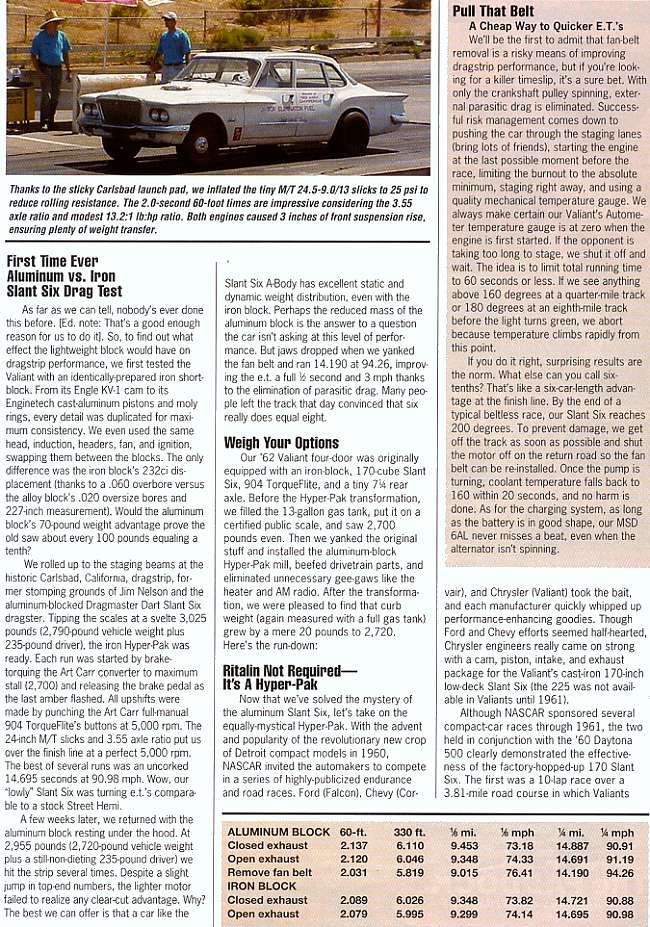
Man I love this stuff! I'm sure you've all seen it, but from the very web site you are on comes a reprint of a magazine article which claims (I tend to believe it) 6 10ths in the 1/4 from removing the belts. Call me crazy, but it makes me think there's gold in them thar belts! http://www.slantsix.org/articles/hrm-sl ... 03-pg2.jpg I understand about no free rides. I figure 3 batteries weigh 100lbs, can be mounted anywhere on the car, and would probably take 10 hours to recharge (using 3 chargers). But I also am guessing that three batteries could run all the accessory loads for maybe 8-10 hours, depending on a whole lot of stuff. And I understand that you'd have to whomp up a step up transformer/power conditioner for proper ignition voltage. If you take a close look at how you drive your slant, you'll see some places to take advantage of this plug-in idea. If you are delivering pizzas 6 days a week in it, then no this might not be the ticket. If you are just cruising or using it for racing/smuggling drugs, then maybe a hybrid approach could work. We will see. If anybody has access to a chassis dyno, make a run with the belt and one without. That will end this discussion quickly. Kip on Truckin' |
|
| Author: | tlrol [ Wed Apr 30, 2008 10:27 pm ] |
| Post subject: | loose the belts, and no suspenders either |
Kip, If you go all electric on the engine's auxillaries you WILL improve your mpg AND you will be holistically more efficient as far as energy use goes. A little bit of unit conversion of BTU's and kwh will make that apparent pretty quick. There is NO internal combustion motor used that is as efficient as the blended efficiency of the interconnected electrical system in North America. Carting around a few hundred pounds of batteries isn't going to ding your mileage anymore than having a passenger. The real point of this exercise is to save you money at the pump--presently, electricity beats the pants out of gasoline for energy/$. Granted, there is a capital cost to adding batteries, and you had best look at the math if you want to recover that. However, my big screen television has NO cost recovery. In fact, merely driving a vehicle is a loosing gig--it NEVER pays me back. It does beat walking however. Apparently, some people think you should do cost/benefits on making a rig more fuel efficient, but they will (with a straight face) recommend performance upgrades that will never "pay" for themselves. That is right up there with the idea that you must have a "net energy gain" crowd--flawed thinking because most of human activity is a net energy looser--entropy sucks and all that. Bottomline: Make your auxillaries electric and keep your batteries charged and you will see an improvement in mileage. Will it pay for itself? I don't know, too many variables. The price of electricty is lower than the price of the equivalent energy content of gasoline is--and it appears that it might be that way forever, if not for a very long time. The only issue with swapping out mechanical pumps for electric pumps and the like on a motor is that you just can't run out and buy something that bolts onto a Slant or other motor--you will most likely have to fabricate stuff or adapt it somehow. A car motor has a bunch of inelegantly designed stuff on it that WORKS for its intended purpose. These things can be built more efficient, but most people don't want to pay $500 for a water pump to gain perhaps 1 to 2 mpg or so (maybe). The alternator is a real load that can be booted for batteries--the question of being able to do this is moot. It can be done easily. Will it pay off the batteries purchased? Depends on gas prices, electricity prices, battery cost, battery charger cost, etc. I know I drank more money (in my youth) than any of this would cost. Do it and see what happens... |
|
| Author: | SlantSixDan [ Thu May 01, 2008 7:06 am ] |
| Post subject: | |
Quote: (I tend to believe it) 6 10ths in the 1/4 from removing the belts.
And how much time do we lose in the 1/4 by hauling a couple hundred pounds of batteries in the car...?
|
|
| Author: | Rug_Trucker [ Thu May 01, 2008 8:26 am ] |
| Post subject: | |
Accell used to sell a switch to turn off the alternator back in the day for racing. |
|
| Author: | ValiantOne [ Thu May 01, 2008 9:00 pm ] |
| Post subject: | |
Quote: Accell used to sell a switch to turn off the alternator back in the day for racing.
One of my buddies who runs a dirt track car at Hagerstown Speedway has a switch in his car to turn off his alternator. I asked him once when, if ever, he used it. I can't even remember what he told me now. C |
|
| Author: | Charrlie_S [ Fri May 02, 2008 5:17 am ] |
| Post subject: | |
Quote: Quote: Accell used to sell a switch to turn off the alternator back in the day for racing.
One of my buddies who runs a dirt track car at Hagerstown Speedway has a switch in his car to turn off his alternator. I asked him once when, if ever, he used it. I can't even remember what he told me now. C None of this will help economy. It is a case of power based on time (amp hours). It will take the same amount of fuel to charge 10 amps for 10 minutes, as charging 5 amps for 20 minutes. How about hooking up a large alternator to the driveshaft. During normal driving, the field is open (no charging), when at closed throttle, the field closes (now charging), this would be similar to regenerative braking. Under conditions, where there is not enough closed throttle to keep the battery charged, the field would be energized, when the battery charge dropped to a certain level. |
|
| Author: | kipamore [ Fri May 02, 2008 5:25 am ] |
| Post subject: | |
Why not just wire the alternator field to the brake pedal light. Or more accuratly, wire the field to a relay that makes when the brake pedal light fires it. Poor man's regenerative braking. It's also not insurmountable to build a "smart" alternator controller. It, say, limits the alternator under 1500rpm for acceleration, kicks it in full for decel, adjusts it for load, widens the historesis during daytime hours, kills it when the pedal is floored, compensates for temperature, etc. That's the essense of the BMW idea. What does a dragstrip calculator show as the power difference needed for 2 tenths at your car's weight and speed? Kip on Truckin' |
|
| Author: | SlantSixDan [ Fri May 02, 2008 11:41 am ] |
| Post subject: | |
Quote: None of this will help economy. It is a case of power based on time (amp hours). It will take the same amount of fuel to charge 10 amps for 10 minutes, as charging 5 amps for 20 minutes.
Good luck, CS. I tried pointing this out and got called a "naysayer" by those who think that if they just believe hard enough, the laws of physics will politely step aside for them. |
|
| Author: | 72DartSwinger [ Fri May 02, 2008 4:18 pm ] |
| Post subject: | |
kipamore: What kind of relay are you suggesting? I think it would be pretty cool to make a brake regenerative alternator or maybe even for the battery? Doesn't the new Prius use something like that? It's worth looking into. Keep the discussion going! |
|
| Author: | kipamore [ Fri May 02, 2008 8:01 pm ] |
| Post subject: | |
SS Dan, You are absolutly right. It's the same flawed logic that says if the instructions say to cook the pizza for 10 minutes at 400degrees, you should be able to cook it for 1 minute at 4000degrees. Tain't gonna work. So you are correct; any gains in turning off the alternator will be negated when you turn it back on. Nods of agreement all around. I'm talking about eliminating the alternator and charging from wall current. Plug in hybrid. Gasoline costs more than 120v, but the electrons don't know that. If you all dig back through this thread, you'll find the link to the BMW article, which purports that their "smart" alternator returned either a 2% or 4% improvement in economy. I'm too lazy to dig out the actual figure. I did dig out this quote from a link in this thread about alternator deletion: - The high efficiency Honda Civic VX and CRX HF models reduce alternator charging under certain cirucumstances. The VX computer instructs the alternator to drop from 14.5 volts to 12.5 (ie. not charging the battery) when all of the following are true: - Load below 10A - Speed below 40 MPH - Engine speed below 3600 RPM - Coolant temp above 140 F - A/C off - Intake air temp above 65 F - Brake switch off - Fuel cut-off not active The dude that wrote it tried it on his car and saw a 10% improvement in mpg. Another dude followed suit and saw 5-7%. I believe these numbers in general. For me specifically, a 3% improvment equates to 200 gallons saved over the course of the year (80,000m @ 14mpg) so I'm horny to pursue the idea. Plus it's just plain fun. And I'm fairly certain that anything that improves mpg will improve performance (and kill the mpg in the process) so it's applicable to all slant sixers. It's not like we have buttloads of power to begin with! Tech stuff: correct me if I'm wrong, but the "old" style voltage regulator was a mechanical dohickey that would close a set of contacts when the voltage dropped below a threshold. That would send juice to the field, which would make the alternator produce AC, which the internal diodes would rectify to DC. Then when the batt voltage went above some set level, the VR would go open, cutting of juice to the field, and the alternator would sit n' spin. As I understand it, you can improve upon that by sending different voltages to the field, thus extracting different amperages from the alternator. A modern "1 wire" alternator does this, and it's all internal. It has an integrated circuit which senses load, and adjusts the field accordingly. Am I wrong about this? Kip on Truckin' |
|
| Author: | kipamore [ Fri May 02, 2008 8:13 pm ] |
| Post subject: | |
Here's the BMW link. I got unlazy. http://www.greencarcongress.com/2006/09 ... uces_.html |
|
| Author: | Charrlie_S [ Sat May 03, 2008 4:41 am ] |
| Post subject: | |
Quote:
From reading that article, it sounds almost exactly what I suggested. I guess us hight teck ingeneeeers, all think alike. What bugs me about all this, is they all overlook the obvious. Build a bare bones, basic, transportation vehicle, without all the bells and whistles. Then you don't need fuel to power all the electrical systems, and move 3 tons of garbage. |
|
| Author: | Rust collector [ Sat May 03, 2008 6:15 am ] |
| Post subject: | |
That is a good point too.. |
|
| Author: | Aggressive Ted [ Sat May 03, 2008 11:11 am ] |
| Post subject: | |
I agree, most folks don't even keep there cars in top form. So they never realize the cars potential. You hear of a few folks out there getting 25 to 30 mpg with their cars and some of them are basically stock, but well maintained. Some capture mileage on trips which is fine but not the average for city driving. So there is a allot of variation on what is good mileage. It may be a little deceiving. I have yet to take my car on a trip since the rebuild. If we go back to basics starting with a good tune up per SL6 Dan's recommendations for plugs, wires, cap, rotor and coil, Then setting the valve lash correctly, Take all the junk out of the trunk, properly inflate the tires and keep them that way, make sure the carb is in tip top shape, recurve the distributor, free flowing exhaust, your almost there............ |
|
| Page 9 of 10 | All times are UTC-08:00 |
| Powered by phpBB® Forum Software © phpBB Limited https://www.phpbb.com/ |
|