Slant Six Forum
https://slantsix.org/forum/

Large tires, weak springs and you.
https://slantsix.org/forum/viewtopic.php?t=26423
Page 2 of 3

Author:  rmchrgr [ Sat Dec 29, 2007 4:46 pm ]
Post subject: 

I kinda have to live with the rear sticking up to clear the tires. It already looks like a Super Stocker with black steelies and the big tires. It's WAY too low right now, hence the clearance issue.

Author:  daniel_depetro [ Sat Dec 29, 2007 5:04 pm ]
Post subject: 

Quote:
Correct me if I'm wrong, but the car looks much lower than the first photo which actually looks kind of jacked-up in the rear.
It is about 7-inches lower than it was previously. That just means the car is now sitting about factory ride height again. The car had either B or E-body springs on it when I bought. Those way to long of springs were bolted on my poor A-body which gave them more arch than St. Louis and McDonalds combined.
Quote:
I actually need to raise my rear end up to get clearance. My springs are sagging which is what causes the rubbing issue.
I realize this and if your springs are flat then a new set will raise it up quite a bit.

This is my 1973 Duster. It too has 'flat' leaf springs in the rear.

Image

There is about at least 3-inch difference in the arch between my new 'stock height' springs and the old saggy springs on my Duster.

Image

Author:  rmchrgr [ Sat Dec 29, 2007 6:59 pm ]
Post subject: 

Dan, I'd agree that 'stock replacement' springs would probably do the trick and bring it up to the correct height. Looks like I'll need to raise the rear at least 3" since the tire is in constant contact with the inner wheel well. I hope whatever I get will provide at least that much lift.

Do you have shackle extenders on the Duster?

Author:  rmchrgr [ Thu Jan 03, 2008 4:48 pm ]
Post subject: 

For anyone following this thread: I purchased a new set of springs from ESPO on Wednesday. 5 leaves, plus I had them arched 2" over stock, just to insure proper clearance. Turns out they're comparable in price JCW, plus they put bushings in and had the hardware relatively cheap. Should be arriving sometime next week.

Hope this takes care of the rubbing issue, I can't wait to drive the car with the all the new stuff.

Thanks for everyone's suggestions. As always, this forum has been very helpful!

Greg

Author:  SpaceFrank [ Thu Jan 03, 2008 5:23 pm ]
Post subject: 

When I bought my '64 Dart, it was already sagging a bit in the back. Rather than put in new leaf springs, I cheated and installed air shocks. :lol:

Author:  daniel_depetro [ Thu Jan 03, 2008 6:05 pm ]
Post subject: 

Stock ride height +2 inches :shock:

I am curious to see your car with these installed.

Keep us updated.

Author:  rmchrgr [ Thu Jan 03, 2008 7:42 pm ]
Post subject: 

Yeah, I guess it's gonna be a little 'jacked up' in the rear... Hi-Jacker style, circa 1975. I guess modifying stuff takes a little backyard engineering. Hopefully it won't look too stupid. It's the anti-lowered-fart-can-ricky-rice-racer look.

Just as an example of a clearance issue, I have a bud with a Toyota Tercel of all things, with lowering springs and larger rims. His brand-new Falkan tires are SHREDDED. He drives over a pebble and the tires scrape. No room for the body to travel before it meets the tire.

I was on the fence about the 2" of extra arch, but since the tires are so much higher than stock, any jounce will make the wheel well meet the tire more easily than normal. Not so much inside the well, but the outside where it flares out above the lip. I thought it would be good insurance.

Author:  slantvaliant [ Fri Jan 04, 2008 8:24 am ]
Post subject:  Re: Large tires, weak springs and you.

Quote:
... but I didn't think they were this bad. They're almost flat across.
While you may need new springs, especially to correct a difference side-to-side or to clear tall tires, the leaf springs should be close to flat for handling. Read Lou's input HERE and more discussion HERE

Author:  LUCKY13 [ Mon Jan 07, 2008 1:56 am ]
Post subject: 

If it comes out to tall, you can always install lowering block to set it down where you want it.


Jess

Author:  Joshie225 [ Mon Jan 07, 2008 10:55 am ]
Post subject: 

Quote:
If it comes out to tall, you can always install lowering block to set it down where you want it.

Jess
The problem with using lowering blocks is if you still have an arched spring you get roll oversteer due to the wheelbase change which is not desirable can be dangerous.

Author:  daniel_depetro [ Mon Jan 07, 2008 2:19 pm ]
Post subject: 

What do you mean "roll oversteer"?

Lowering blocks do not change your wheelbase.

Author:  Joshie225 [ Mon Jan 07, 2008 3:30 pm ]
Post subject: 

If you flatten out an arched spring it becomes longer. The outside spring in a corner gets flattened out, becomes longer and steers in the rear end into the corner. This is roll oversteer.

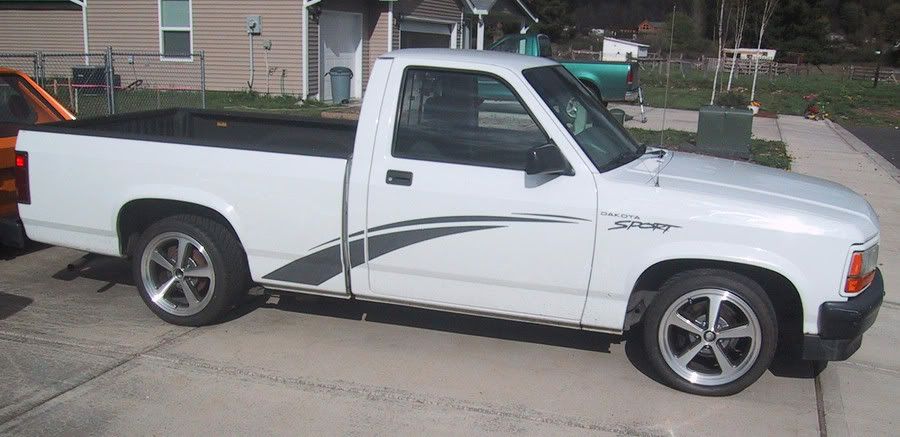
I'm perfectly aware of this. I have cast iron lowering blocks in my Dakota to compliment the lowering spindles up front. It would have been better to move both front and rear leaf spring mounts up on the frame as the BellTech kit does, but the blocks cost 1/4 as much.

Image

P.S. Those wheels are going onto my '67 Valiant as soon as I'm done with the rear axle work.
Quote:
What do you mean "roll oversteer"?

Lowering blocks do not change your wheelbase.

Author:  rmchrgr [ Thu Jan 10, 2008 3:23 pm ]
Post subject: 

Springs arrived from ESPO the other day, hopefully will be installing them either tomorrow or Monday. Will let everyone know how it turns out.

The project stopped because of the tire rubbing. I now need to re-do the alignment/ride height and get the brake proportioning sorted out after the new springs are in.

Will update soon!

Author:  Sam Powell [ Thu Jan 10, 2008 7:14 pm ]
Post subject: 

If you have a place to store them, don;t throw your old springs away. If the new ones flatten out too much, you can take a leaf out of your old spring pack and add it in to bring things back up. The longer ones are the ones you want to save, included the vary top one with the eyes. If you want a really long additional spring, cut the eyes off, and add that one as spring number two, or replace the existing spring number two.

The sag usually happens between the end of spring number two, and the shackle. So if you lengthen spring number two, the sag is less. If you don't want to raise it too high, then replace spring number two, with your home made longer number two. This only applies if the new ones sag, which I have seen happen. You can also use the front half of the longest spring to stiffen just the front as they did on the hemi cars to minimize spring wrap up, and push the rear into the pavement more firmly.

Sam

Author:  Sam Powell [ Fri Jan 11, 2008 4:54 am ]
Post subject: 

Josh, I've thought about your comments aoubt the wheel base shifting in a leaning situation, and I think this is a problem with my car. It did not show up until I stiffened up the front end however. I drove it for years with a high arch rear spring set, and sway bars front and rear with no ill effects. Now it does exhibit firghtening oversteer in curves that comes on rather unexpectedly. I thought it was just because it sits too high, resulting in a cneter of gravity that is too high. Your comment has got me to thinking. What is the ideal rear axle behavior? It is possible to design things several different ways, with different outcomes.

Here are my thoughts on the situation: Forgive the length, but it requires 1000 words since I don;t have a single picture.

The change in wheel base is as much because the vertical relationship of the axle center to the front hanger bolt changes relative to the center line of all four wheels, which would be level to the ground, if all wheels and tires are the same size. The front half of the spring is considerably shorter than the rear, which means the front is stiffer, and the last to change it's shape, but it does rotate continually around the front hanger bolt. This means the axle is traveling in a circle around the front hanger bolt as it moves up and down, and the wheel base is constantly changing by small amounts. If the axle sits at rest higher or lower than the front hanger bolt, then the wheel base for that side will get longer when it goes wither up or down.

The rear of the spring does most of the shape changing, since it is longer, and actually more flexible by virtue or where the lower support springs end in ralationship to the shackle. The shackle is free to move front to back to accomodate the changing arch of the rear spring as the axle moves up and down.

Obviously, the longest wheel base would be when the front of the axle arch was flat, and when the wheel center was level with the front spring hanger for the rear leaf. If the design of the spring arch was such that the center of the axle was level with the front hanger bolt, and the arch was flat in front, then the wheel base would only get shorter as the car leaned either way, on both sides. The rear of the spring would not have any effect on this dynamic. True it supports everything in its way, but since the shackle is free to move front and back, it does not force the axle in this movement. Only the front of the spring has this effect.

When a car with the front hanger bolt level to the axle center tilts, the wheel on the down side, gets pulled shorter by virtue of entering the lower part of the circle described by the axle around the front hanger bolt. The wheel on the up side also get shorter,because it is entering the top side of the circle. There would be no shift in the squareness of the wheel base. It would only get slightly shorter. This would be true only as long as the front arch did not change shape. You could guarantee this by strapping a really strong piece of channel, or other stiff shape to the front section.

So it seems if the goal is to keep the axle always square, then get the axle center level with the front hanger, and stiffen up the front section. The easiest way to do this would be with lowering blocks. If the rear axle center is low in relationship to the front hanger, simply put blocks of the correct thickness in there. You would have the concern of drive shaft vibration if you get the pinion angle wrong.You would be changing the front u joint angle more than the rear one. They sell shims at 4x4 shops to correct for that.

When my car was factory, the right rear wheel was 1/4" further back than the left one. It handled quite strangely until I put a 1/4" shim between the front hanger and the body mounting for the pad. Everyone who followed me down the road remarked at how the car crabbed it's way down the road. Even my wife made note of it. I did not make any fancy measurements, I just guessed, and bought a 1/4" plate, drilled the holes, and installed it. When I had the wheels aligned they said the rear toe was perfect, so I just lucked out.

So Josh, I ask, is the ideal to have the rear axle remain perfecty square in curves, or is it desirable to have some shift one way or the other. What do these new 4 wheel steering vehicles do? Do they steer to the left in a right hand curve, or do they stear to the right in a right hand curve?

One thing is clear, the design of your rear spring mounting, and spring shape is very important.

Sam

Page 2 of 3 All times are UTC-08:00
Powered by phpBB® Forum Software © phpBB Limited
https://www.phpbb.com/