Slant Six Forum
https://slantsix.org/forum/

Manifold Gaskets
https://slantsix.org/forum/viewtopic.php?t=32100
Page 2 of 3

Author:  63dartdude [ Fri Nov 21, 2008 9:53 pm ]
Post subject: 

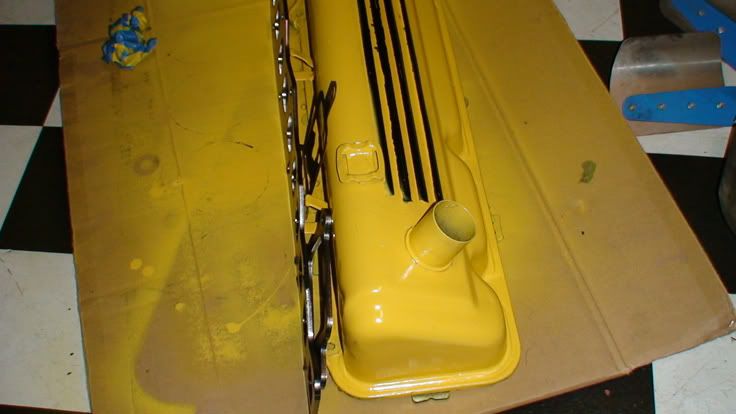
The Aussie one was thicker than the ones you get at the auto store. But the REMFLEX is totally different. This photo might help.
Image

It reminds me of Lead. You can take your fingernail on it, and write your name. In this photo, up against the valve cover I have the metal gasket that goes between the intake and exhaust manifolds. Below that is the Remflex one. Look how thick it is compared to the metal one. The manifold gasket is there as well. If you look closely, you can see how thick it is. And again, almost like lead. Hard, but soft, if that makes sense.

Author:  ceej [ Fri Nov 21, 2008 10:02 pm ]
Post subject: 

your photo is hard to decipher.. Have you assembled things, or can you take more? :)

CJ

Author:  SlantSixDan [ Sat Nov 22, 2008 6:49 am ]
Post subject: 

Quote:
The Aussie one was thicker than the ones you get at the auto store. But the REMFLEX is totally different
It almost looks and sounds like you might not actually have seen or used the Australian gasket. The parts store gasket is not the Australian gasket! The Australian gasket (link here) is like the Remflex gasket: Very thick, conformable graphite composite material.

In any event, the real measure of a gasket's worth isn't how thick it is when we hold it in our hands. It's how well, how easily, and how reliably it seals when installed. Both the Remflex and the Aussie gaskets seem to do equally well, i.e., much better than anything you can buy at a parts store!

Author:  63dartdude [ Sat Nov 22, 2008 9:56 am ]
Post subject: 

Yep, I agree with you about how well it works. And I also believe they both are great. I just like the Remflex one better. The one from Aussie I had a problem putting on, since on the end it was 90 degrees at the bottom. Whereas the Remflex and one from the auto store isn't 90 degrees at the bottom on the end. So they go on much easier.

http://catalog.remflex.com/category_s/87.htm

http://www.gprsmopars.com/shopping/pgm- ... ?id=5&=SID

The photos on those two sites, pretty much show what I mean about the 90 degrees.

Author:  56 Dodge [ Sun Nov 23, 2008 3:32 am ]
Post subject: 

I have received my Remflex gasket and I have ordered an Aussie hot box gasket before I received the gasket set from Remflex. I was surprised and disaponted with Remflex the picture on their site shows the manifold gasket only when I received the gasket it was a set manifold and Hot Box. I could have saved some money had I know that the Remflex company did not show the whole picture. I have yet to install the gaskets, but I am very impressed with their appearance. Just my two cents.

Author:  6shotvanner [ Sun Nov 23, 2008 9:26 am ]
Post subject: 

56,I believe when Remflex started with the slant gaskets the hotbox wasn't included.Our own Aggressive Ted brought it to their attention and when mine didn't have both a call to them and the secret password "slant6dotorg"and next day UPS was here.Thanks to Ted it's a gasket "set" now they just haven't updated the website I guess.This was going on about a year +- ago? Remember 5 ft lbs torque is all they need.

Author:  Aggressive Ted [ Sun Nov 23, 2008 10:17 am ]
Post subject:  RemFlex gaskets


Author:  sam03v [ Thu Dec 11, 2008 2:18 pm ]
Post subject:  gasket sealant

Is it necessary to use gasket sealant with the gaskets from GPRS? I've read the detailed post about the Super Six installation and it does recommend sealant for the standard gaskets so I was just wondering if it is needed for the Aussie gaskets.

Author:  SlantSixDan [ Thu Dec 11, 2008 3:09 pm ]
Post subject: 

That's a good question. I would probably not use a sealant with the Australian or Remflex gaskets. There's really no need.

Author:  sam03v [ Fri Dec 12, 2008 5:56 am ]
Post subject: 

No sealant it is. I ordered the gaskets yesterday(Australian). Thanks.

Author:  '74 Sport [ Sun Jul 03, 2011 2:30 pm ]
Post subject:  Reviving old thread

I realize this is a very old thread, but it addressed the problem Aaron and I are now facing with his manifold assembly. We pulled everything apart, had a broken-off bolt drilled and retapped for the single one that is on the engine side of the carburetor for the intake/exhaust connection (some call it the "hot box" or "stove box" or "heat riser".)

Aaron bought the improved gasket set from Australia with the graphite composition. Everything went back together fine, we started the engine and still noticed a slight "puffing" exhaust leak. Feeling around the area, a leak was found at the inboard side of the heat riser where the new gasket was to hopefully seal between the manifolds. Inspection with a mirror underneath the intake revealed a slight gap between the manifolds where the gasket is not being compressed. Tightening the bolt had no effect on closing the gap, even with loosening the two outboard bolts first to relieve any tension. Should we have also loosened the nuts on the manifolds-to-head?

Here's the obvious question... now what? If the thicker Aussie gasket isn't sufficient, would the Remflex gasket be a viable solution? How much thicker is the Remflex than the Aussie one? We need to close up a gap roughly 1/16". The Dart is due to have a safety inspection Tuesday, so in the interim we plan to build up a thick bead of hi-temp RTV on a standard stamped-metal seal we have and once cured, slip it between the Aussie gasket and the intake manifold. This may be a short-term fix, but we need to have a long-term solution.

Better yet, perhaps some of you can lead us through the proper sequence of tightening and torquing all the intake-to-exhaust bolts and intake/exhaust-to-head nuts. Could it be that warpage has occurred over the past five years the car has been on the road since its rebuild? Maybe thicker gaskets or doubling up on gaskets is the only solution?

Thoughts or ideas are welcome...
Jerry

Author:  Aggressive Ted [ Sun Jul 03, 2011 11:27 pm ]
Post subject: 

Some thoughts....since everything on mine was over 35 years old and not flat like when they were new.....

I have used many brands of gaskets through the years and none of them including the Aussie gaskets are not as thick as the Remflex.

The Remflex gasket material is much thicker about 3/16 thick. I have found it to be plenty thick to seal between the two manifolds in the stove box area.
I generally use a 3/4" thick ply sanding board made from 16 ply birch with an old 80 grit sanding belt tacked to it to sand flat the manifold surfaces. If they are badly pitted they must be sanded or ground flat for a good seal.

I usually snug up the exhaust manifold at each end (front and rear) first to about 5 lbs. Then the center nut on the intake. Then the rest per the sequence in the manual. I go around snugging them up with a 1/4" torque wrench at least 3 or 4 times bringing them up to torque gradually. Don't go too tight or the manifold can't move around during warm up and cooling. If you over torque the manifold it will crack.
Next snug the large center bolt at the stove box, then the other smaller two. I use stainless steel bolts for all three stove box locations. I generally drill the exhaust manifold at the two smaller outside bolt locations and use stainless flat washers, lock washers and nuts. I torque the 3 stove box bolts equally.

Believe it or not on the Remflex gaskets with an even torque even at 5 lbs. on all brass nuts the manifolds will seal just fine. The key is to not overly torque and squish the Remflex gasket material on the SL6. The manual says 10 lbs. for the the stock steel gasket.

Author:  DusterIdiot [ Mon Jul 04, 2011 12:09 am ]
Post subject:  Not true on every scenario...

Quote:
Believe it or not on the Remflex gaskets with an even torque even at 5 lbs. on all brass nuts the manifolds will seal just fine.
That setting failed to seal my early clifford hyperpak manifold and the dutra duals, to keep the exhausts uniformly sealed took 15 ft lbs...I would expect 5 ft/lbs to be correct for a single iron manifold and exhaust manifold mated pair.

That being said the disadvantage of the remflex gaskets is now very evident if an exhaust or header experiences extreme backfire or the pipe is "loaded"...I just fragged one yesterday during an engine break in...The hotbox gasket I got from GPRS was unaffected....

FYI,

-D.Idiot

Author:  '74 Sport [ Mon Jul 04, 2011 8:41 am ]
Post subject: 

Sounds like our best bet for now is to give it the ol' college try with the steel gasket and RTV, in addition to the GPRS. If that seals well enough to get through the inspection tomorrow, a Remflex gasket needs to be bought as a back-up replacement to keep on hand.

Thanks for the input.

Author:  Jester [ Mon Aug 08, 2011 12:43 am ]
Post subject: 

Quote:
Sounds like our best bet for now is to give it the ol' college try with the steel gasket and RTV, in addition to the GPRS. If that seals well enough to get through the inspection tomorrow, a Remflex gasket needs to be bought as a back-up replacement to keep on hand.

Thanks for the input.
I had the same problem with my Aussie hotbox gasket. It was quiet and sealed well for a few months, maybe 200 miles put on since install... Then the puff puff and a much louder exhaust note under the hood. I stuck my hand down the side and felt the exhaust blowing out of the rear corner nearest the manifolds. Took out my trusty camera and saw a small gap.

After removing everything, it appears my special gasket blew chunks of "graphite" right off the metal innards, resulting in a fairly major exhaust leak. I would advise using a little copper RTV on both sides of that gasket, if only to keep the "graphite" material from disintegrating and blowing out.

Granted, my 34 year old manifolds are likely pretty warped, I'll be trying Remflex next.

Page 2 of 3 All times are UTC-08:00
Powered by phpBB® Forum Software © phpBB Limited
https://www.phpbb.com/