| Slant Six Forum https://slantsix.org/forum/ |
|
| Aluminum slant build https://slantsix.org/forum/viewtopic.php?t=38763 |
Page 3 of 6 |
| Author: | Kevin Johnson [ Fri Jan 29, 2010 3:12 am ] |
| Post subject: | |
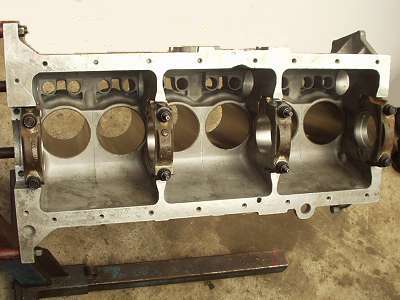
Look in the crankcase of the aluminum block next to the lifter galleries (non-thrust side of the cylinders). If you make this a wet liner you will be weakening the block substantially by breaking the surface as it transitions from the cylinder to the block interior. I am sorry that I don't have a block at my feet but I do collect and carefully examine pictures that many of you and others have posted of the alloy block. As the contiguous casting exists it is able to survive with the known difficulty that the deck sealing area is poor and unstable. Be careful about introducing new problems. Edit: Here are a couple of pics before your eyes versus at your feet: Iron ![]() Aluminum
|
|
| Author: | SlantSixDan [ Fri Jan 29, 2010 7:22 am ] |
| Post subject: | |
I also think it's high time Kevin answered Sandy's valid questions. |
|
| Author: | Dart270 [ Fri Jan 29, 2010 7:24 am ] |
| Post subject: | |
Sandy, Thanks for the memories. I vaguely remember our conversation, but not all those details. If this new deck plate were 1" thick, would you think to weld it to the existing block, since it doesn't have meat to bolt into once you mill off 1" (bolt hole castings end there and can't be drilled deeper. Yes, bore could easily go to 3.5" or more with new liners. If I get time this afternoon, I plan to run a few ideas by my machinist with a block at our feet to look at... All of this talk has me tickled about building a HO Alum engine using a std or copper head gasket and modified headplate/liners, etc. Lou |
|
| Author: | Doc [ Fri Jan 29, 2010 8:32 am ] |
| Post subject: | |
Here is a better photo of the lifter area in the aluminum SL6. ![]() Yes, this area in the aluminum block is weaker then it's cast iron "brother" but it works... I do not think this area is the main problem with the aluminum SL6 engine's ability to maintain a head gasket seal. As already noted, it is the open top deck and the resulting lack of cylinder support that is the main issue we are addressing. This is also the reason why a big bore, resleeved iron block also develops sealing issues, you loose a lot of the built-in strength when the tops of the bores are "cut loose" from the top deck structure. A single piece engine block casting, with cylinders encased between integral top & bottom decks, is a strong structure. Take one of those "caps" (decks) away and the structure is a lot weaker. DD |
|
| Author: | passing you [ Fri Jan 29, 2010 11:24 am ] |
| Post subject: | |
hmmmm....not much option with this. filling the upper deck, will still have the block expanding loose, most likely. deck plate more than 1/4 will leave us with no head bolt threads. 1/4 isn't a lot of structural integrity gain, unless usjg steel, but then expansion rates.... 1 cylinder is corroded to the iron liner. can't spray the iron without melting the aluminum around it... need some kind of super epoxy. |
|
| Author: | SlantSixDan [ Fri Jan 29, 2010 11:47 am ] |
| Post subject: | |
Quote: need some kind of super epoxy.
Like Belzona, perhaps. See threads here, here, here, here, and here.
|
|
| Author: | adiffrentcity [ Fri Jan 29, 2010 4:26 pm ] |
| Post subject: | |
The Belzona 1111 and 1121 sound like the ticket. If one were to borrow kevin's idea of filling the block with common wax (taking care to keep it off the top of the block inner water jacket area and tops of the cylinders on the water jacket side) to about 1" or whatever you like, then pour in the belzona and let cure; It seems you could make the top of the block substantially more rigid. Heat to melt out the wax then use standard machining techniques to true the bores and cut the deck nice and flat. It should be no more expensive than a standard block prep except for the cost of wax and epoxy. If you were creative, you could use a similar technique to "siamese" the cylinder bores and leave the block as an open deck if you prefer. *IIRC those machined inserts for hondas are made to fit snugly around the cylinder bore area and have "file to fit" pads on either end (longways) to fit very snug without the risk of falling. Seems they are able to do this because the castings are very similar from one block to the next due to more modern casting techniques. Probably not something easily done on one of these aluminum blocks for the opposite reason. I like sandy's idea of re-sleeving and was thinking of doing something like that (someday) on an iron block. DISCLAIMER: I don't, and have never owned an al block slant. I just like to think things like this through; join the discussion and share my thoughts (hopefully) for the benefit of everyone here. |
|
| Author: | Doc [ Fri Jan 29, 2010 4:42 pm ] |
| Post subject: | |
Quote: The Belzona 1111 and 1121 sound like the ticket.
I have done this by plugging the water pump opening and filling the block to with-in an inch of the top surface, with dry sand. After the new deck is "poured & cured", remove the plug and pour the sand out.If one were to borrow Kevin's idea of filling the block with common wax (taking care to keep it off the top of the block inner water jacket area and tops of the cylinders on the water jacket side) to about 1" or whatever you like, then pour in the belzona and let cure; It seems you could make the top of the block substantially more rigid. Heat to melt out the wax then use standard machining techniques to true the bores and cut the deck nice and flat... The biggest challenge with "casting-in" any new material is shrink. (or expansion) Most epoxy materials shrink when they cure. This causes stresses, warpage and "pull-away" of the material, where it meets the aluminum. DD |
|
| Author: | adiffrentcity [ Fri Jan 29, 2010 4:51 pm ] |
| Post subject: | |
Quote:
I have done this by plugging the water pump opening and filling the block to with-in an inch of the top surface, with dry sand. After the new deck is "poured & cured", remove the plug and pour the sand out.
Dang, what epoxy did you use? I'm going to the belsona site to see if they reference shrink upon curing...
The biggest challenge with "casting-in" any new material is shrink. (or expansion) Most epoxy materials shrink when they cure. This causes stresses, warpage and "pull-away" of the material, where it meets the aluminum. DD |
|
| Author: | Joshie225 [ Fri Jan 29, 2010 4:51 pm ] |
| Post subject: | |
What Doug brings up about having the cylinders with a deck on the top and bottom adding rigidity got me thinking. What if instead of individual sleeves being supported in the aluminum block we removed all of the AL block's cylinders and had a weldment or casting with upper and lower decks as one piece with 6 new cylinders? The new cylinders would be siamesed to help support one another and this cylinder unit would be a light press fit in our machined aluminum case. The head would bolt to the new cylinder structure and I would extend the main bearing studs into the new cylinder block as well. This would make the new cylinder block the main structure which holds the cylinder head and crank in relation to the cylinders. Much of the stress is then taken off the AL block. Of course this adds weight, but it could also add a lot of strength and give us much larger bores. |
|
| Author: | wvenable [ Fri Jan 29, 2010 5:01 pm ] |
| Post subject: | |
Josh, good idea! But.... (edited) Wow that didn't take long! |
|
| Author: | sandy in BC [ Fri Jan 29, 2010 5:12 pm ] |
| Post subject: | |
I dont think welding the top deck to the block is an easy way to do this. I had envisioned machining away everything except the perimeters of the block to the depth of the top plate....then bolting and expoxying the new deck into the block. One would need to machine new water ports , pushrod holes and head stud holes into the new deck. Essentially you are creating a whole new top deck for the block. If slants didnt have such a long stroke already you could even raise the deck height. Mebbe you want it shorter. By creating a new deck to support the top of the liners you negate some of the rigidity loss on the bottom end. Im not so freeked about the new wet liners leaking . I think creative blockrocking could take care of that. so.....would you weld the siamesed liners together? Can they be pressed in in pairs? How thick would you make the aluminum top deck for head studs/bolts? It makes no difference to a machinist whether the top deck is 1"or 2 " or whatever. Can the top deck be cross bolted to the block? What head would you bolt on the new deck? (no fair saying Supra) |
|
| Author: | adiffrentcity [ Fri Jan 29, 2010 5:15 pm ] |
| Post subject: | |
Anyways went to the Belzona site and according to their technical flyer, formulation 1121 does not heat up, shrink or expand on curing and is solvent free! Read all about it! |
|
| Author: | sandy in BC [ Fri Jan 29, 2010 5:16 pm ] |
| Post subject: | |
Josh posted while I struggled to articulate the same ideas.......he just took it the next step along. |
|
| Author: | wvenable [ Fri Jan 29, 2010 5:25 pm ] |
| Post subject: | |
ADC guess you managed to read my post. Thanks for the info! |
|
| Page 3 of 6 | All times are UTC-08:00 |
| Powered by phpBB® Forum Software © phpBB Limited https://www.phpbb.com/ |
|