| Slant Six Forum https://slantsix.org/forum/ |
|
| distributor recurve https://slantsix.org/forum/viewtopic.php?t=41539 |
Page 1 of 1 |
| Author: | oklahoma joe [ Fri Aug 20, 2010 8:48 pm ] |
| Post subject: | distributor recurve |
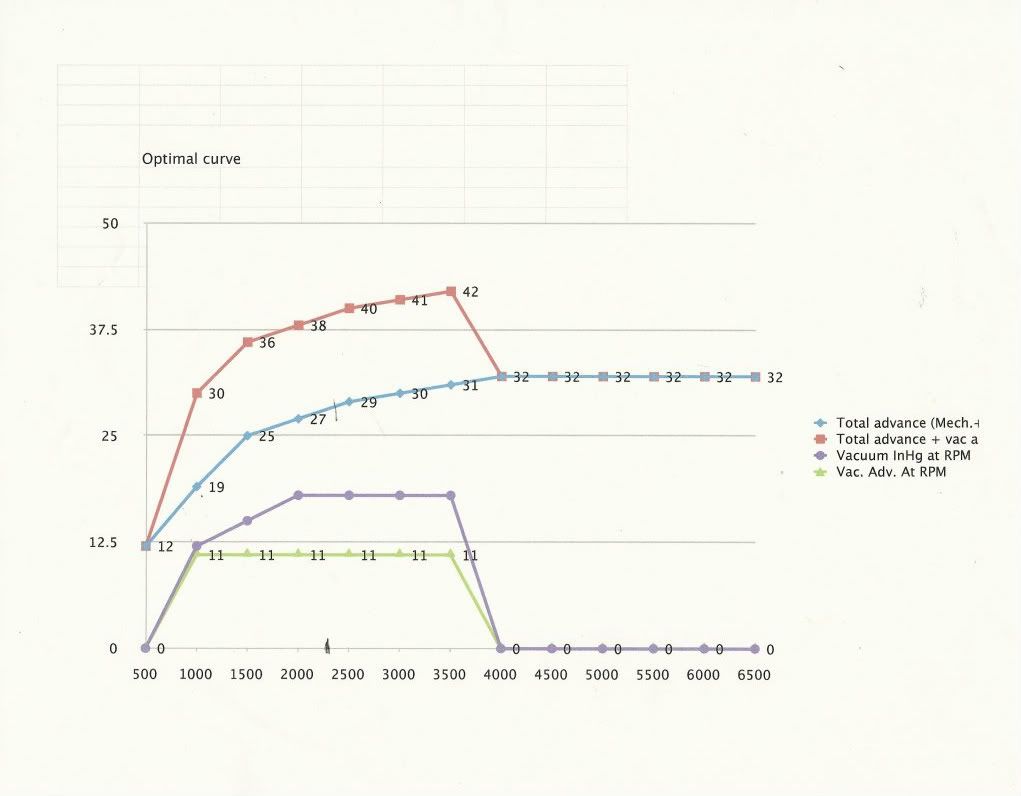
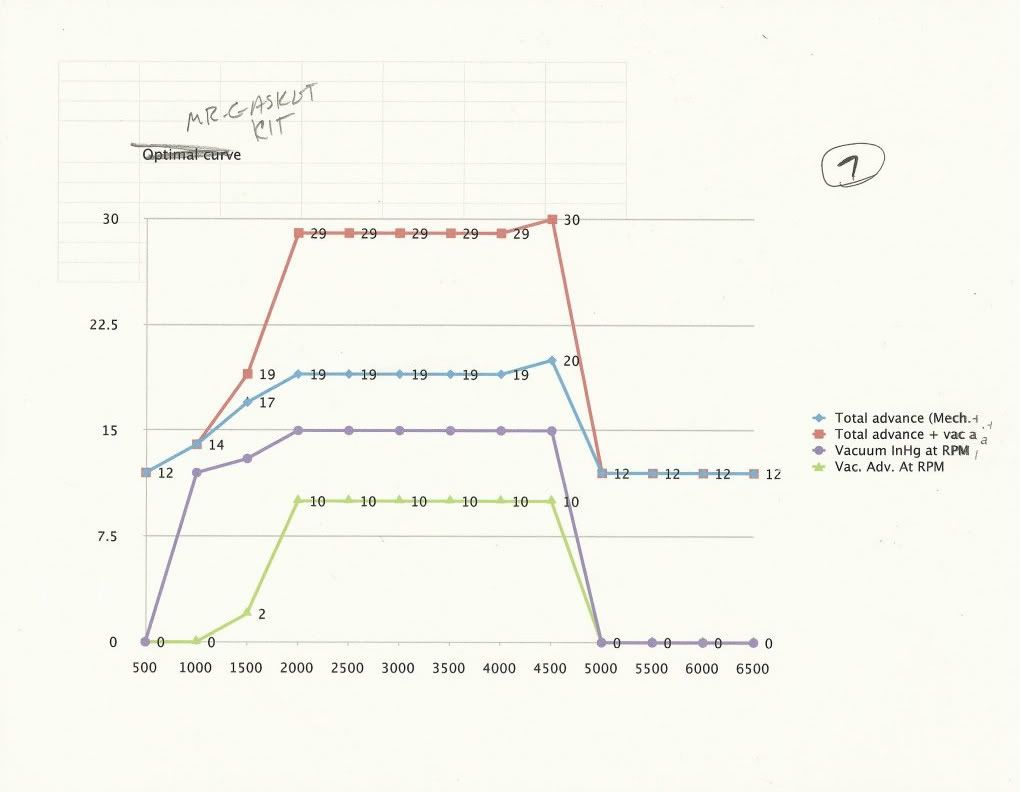
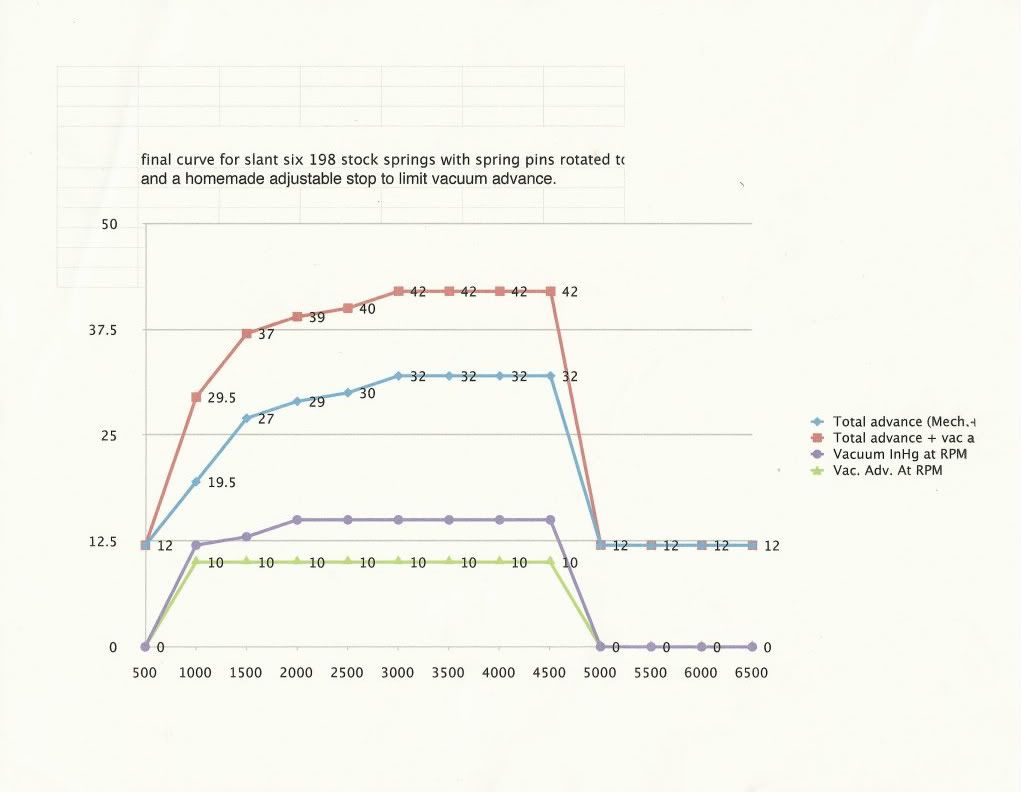
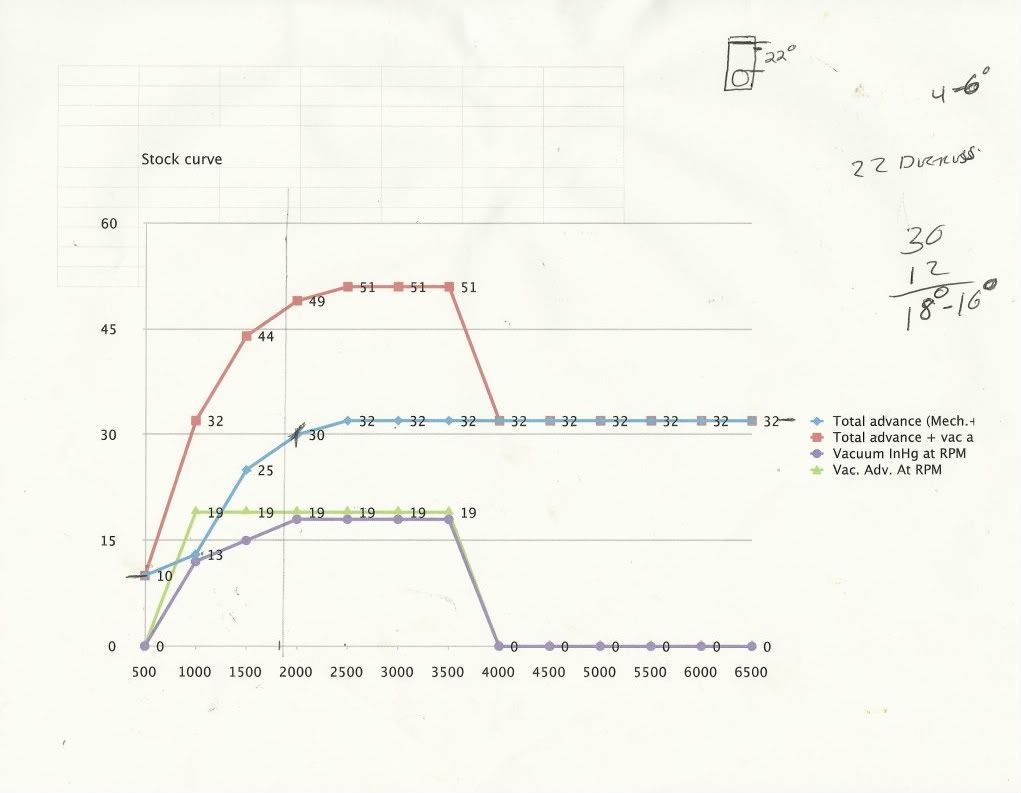
I'm in the process of learning how to recurving my distributor. I have figured out that there are two springs one stiff and one light. The light one should handle the low rpm stuff and the heavy the higher stuff. My higher spring has a slot it it that keeps it from engaging until later. When I plot the mechanical advance it gives me about 22 degrees at 2500 rpm and then levels out from there. The thing I am trying to figure out is the heavy spring with the slot is so stiff it never stretches any so it is acting more like a stop then a spring. I verified this by taking out the shaft and attaching it to my 1/2" drill and spinning it at 1500 and 3000 rpm, while watching it under my daughter strobe light. (kinda 1970's but it worked) The rpms at the distributor should equal 3000 and 6000 crank rpms. The big spring did not stretch until just over 4500 rpm at the crank. I also have a slide plate on the governor that is marked with a "15R" which I think means it should produce 30 degrees at the crank of advance. So I tried a Mr.gasket spring advance kit and I did not like it. I was kind of an all or nothing deal with very light springs. I made a spread sheet to try to visualize the curve it you want to see below. The one marked Mr.gasket was my first attempt not so good. It had maybe better low end poor top end. The one marked optimal is what I think I want to try for. The one marked stock was measured before I took it apart for base line. SO after all that here are my questions: Is there a place that sells the heavy springs with the slots in a lighter spring rate so I can have that spring kick in a little sooner at a usable RPM range for my application (2000 to 4500 rpm)? and I have been reading about the advantages of manifold vacuum to the vacuum advance has anyone tried this if so how did it work? The main thing I am interested in is lower idle temperatures. Its been around 105 for the last month around here. Thanks Joe:) ![]() ![]() ![]() |
|
| Author: | DusterIdiot [ Fri Aug 20, 2010 10:08 pm ] |
| Post subject: | Yep... |
15L= 30 degrees...but you want more initial otherwise you'll be setting this dizzy to '0'/TDC on set up... The Mr.Gasket Kit for Mopar...and the Ford version have light springs for "DRAG RACING" only...the mopar one says all in by 1200 rpm...so just off idle...you have 100% mech advance)... He job of the springs is kind of two fold...the long slot heavy spring allow the timing to ramp up through the "slot", only to be governed by how fast the lighter spring allows it...if you set it right...when the advance hits the end of the slot...the big spring will slow down the advance that little bit to allow just a couple of degrees before topping out...and allowing the advance to slowly reach the end of the governor slot...if the advance is too quick the pins in the advance weights will slam against the end og the governor slot...then rebound a bit once the spring slackens then do it again...you'll see the effect by watching your timing mark jump back and forth at max advance by 4-8 degrees each side of the timing mark. You can get a spring kit from one of our users (do a search), or you can also experiment with using the Mr.Gasket Chevy spring kit... black spring for aggressive advance(use heavy slotted spring in each case, and roll the dizzy shaft spring pin out a bit to get it to catch sooner), use the silver spring for moderate advance/daily driving. Looks like you are on the right path. -D.Idiot |
|
| Author: | ceej [ Fri Aug 20, 2010 10:27 pm ] |
| Post subject: | |
What is the car going to be used for? That can play a big part in how you curve or lock the advance. Many drag racers employing adders lock advance out completely to avoid any increase in timing. For a street car this isn't desireable. Using manifold vacuum will cause you to have full vacuum advance when you don't want it. The vacuum advance should only come into play when at partial throttle and cruise situations, which is why ported vacuum is used. CJ |
|
| Author: | Aggressive Ted [ Sat Aug 21, 2010 8:30 am ] |
| Post subject: | |
Joe, Have you you thoroughly read the Recurve instructions in the the Engine FAQ? How is your car setup? compression? Exhaust? cam? rear ratio? weight? racing? street car? mileage? Recurving is fine tuning your car for a specific out come. We need to know what you want in the end. "Bigslant6fan's" MOPAR spring kit comes with a spring chart with advance plots. Yes, you can find various long slot secondary springs. The best way is to pull springs from 340, 440 engines through 1969. In later years some 383's and 400's had some great spring selections. |
|
| Author: | olafla [ Sat Aug 21, 2010 11:36 am ] |
| Post subject: | |
Hi oklahoma joe. First of all, I absolutely love it when someone improvise the tools they need, great using your drill and strobe light instead of a costly distributor machine! You can get spring kits from one of our members 'bigslant6fan'. Just send him a pm, but remember he doesn't read his pm's every day. He also has the diagram with the curves for different spring combos. I bought his kits, and also bought a Mopar Performance spring kit from Summit, originally made for V8's, that contained a lot of springs. Like Doc once said, take care to save all the springs you find, you might find just the right one when you need it. I haven't gotten round to measure the different spring rates yet, I thought about making a small fixture and use a simple spring scale (fishing gear!) to measure the force necessary to stretch the springs at small increments (1mm?) up to the max length they will have in a dizzy. That should give some indication about which one to use. Olaf. |
|
| Author: | olafla [ Sat Aug 21, 2010 12:08 pm ] |
| Post subject: | |
One more thing Joe, you stated you want to lower the idle temperature. Just to mention another approach to solve your problem; are you familiar with the so called TIC-valve? It is a small temperature controlled valve that is screwed into the front part of the cylinder head, I guess it turned up as part of the emission systems. It has input ports for both ported vacuum and manifold vacuum, and a output port with a hose to your distributor advance pot. It lets through ported vacuum in it's normal state, but when the temperature rises about a certain level, it opens for manifold vacuum instead of ported vacuum (which is zero at idle) to give more advance thus raising the idle speed a little for better cooling. Olaf |
|
| Author: | oklahoma joe [ Sat Aug 21, 2010 2:28 pm ] |
| Post subject: | |
Quote: One more thing Joe, you stated you want to lower the idle temperature. Just to mention another approach to solve your problem; are you familiar with the so called TIC-valve? It is a small temperature controlled valve that is screwed into the front part of the cylinder head, I guess it turned up as part of the emission systems. It has input ports for both ported vacuum and manifold vacuum, and a output port with a hose to your distributor advance pot. It lets through ported vacuum in it's normal state, but when the temperature rises about a certain level, it opens for manifold vacuum instead of ported vacuum (which is zero at idle) to give more advance thus raising the idle speed a little for better cooling.
That a neat idea about the tic valve. I might try it if I can find a hole to stick it in. Olaf Joe [/img]
|
|
| Author: | bigslant6fan [ Sun Aug 22, 2010 11:01 am ] |
| Post subject: | - |
The TIC valve was a last resort when the engine was already badly overheated,230-240 degrees if I remember. |
|
| Author: | olafla [ Sun Aug 22, 2010 1:42 pm ] |
| Post subject: | |
Hi Joe. Clever stop screw! Do you use a dial-back timing light for the readings while running in the car, or do you have some fixture for your drill and a degree wheel? There may be one or two others on the forum that can't afford a distributor machine either... The TIC valve was only used 'on some cars equipped with the "Maximum Cooling Package" and/or air condition', according to the manual. That usually means police and fleet cars. I know that police cars also had an AC cut-out switch, and I would guess only police and fleet cars had the TIC valve, and as bigslant6fan says, it is last resort! I haven't recurved my dizzy yet, so what you have come up with is very interesting. Please post your car and engine vitals. Olaf. |
|
| Page 1 of 1 | All times are UTC-08:00 |
| Powered by phpBB® Forum Software © phpBB Limited https://www.phpbb.com/ |
|